Locate Us
tooth leaning right tooth leaning left big tooth big tooth
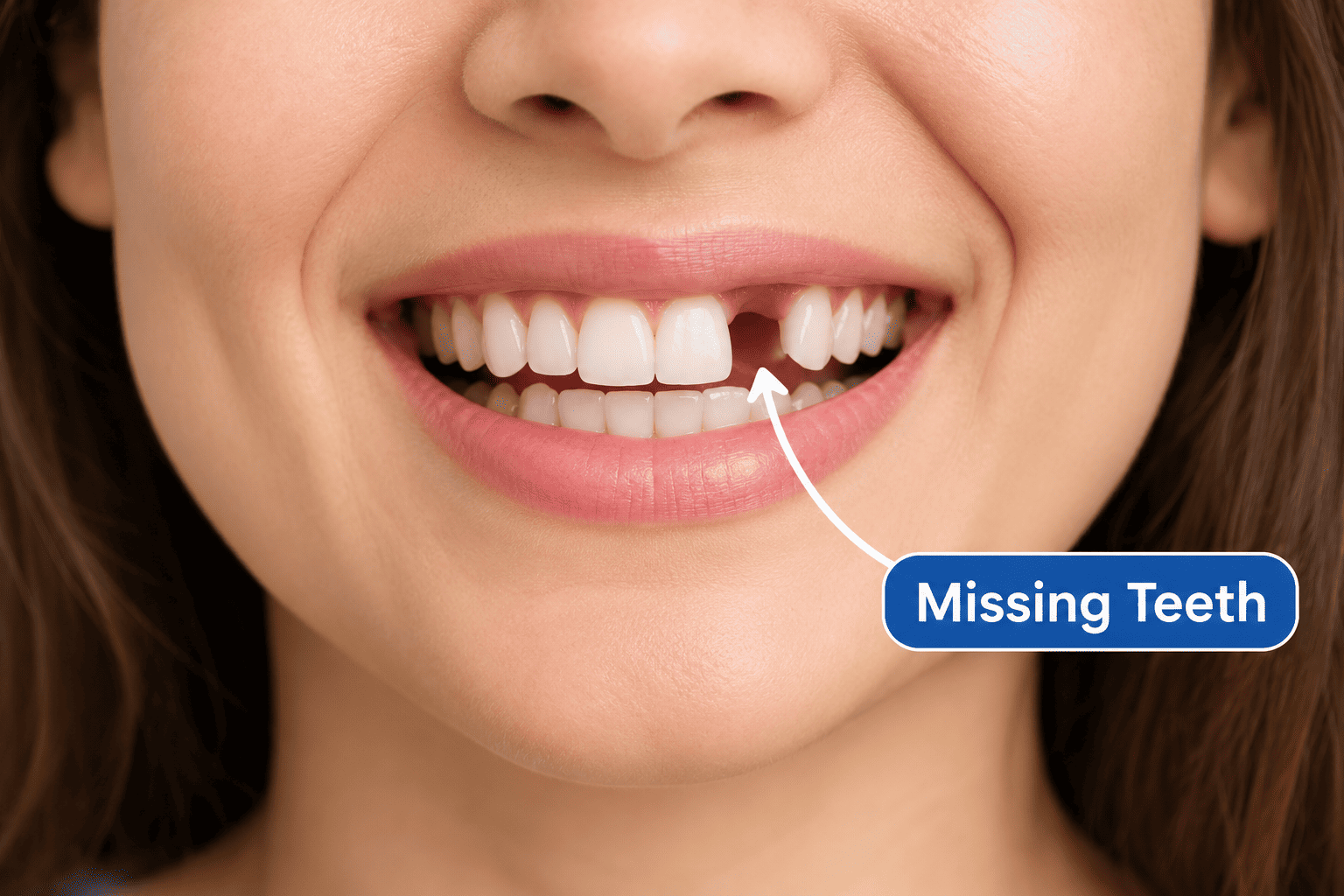
Smiling Woman with Missing Tooth

Missing Teeth

A missing tooth can make chewing, speaking and smiling feel awkward. Even if you get used to the gap, the teeth beside it may shift and the jawbone can change over time. Whether a missing tooth needs replacing depends on its position, your oral health and how the gap affects your bite.

You can replace missing teeth with an implant, a bridge or a denture. Knowing how the three differ makes it easier to discuss the right option with your dentist.

What Are Missing Teeth?

Missing teeth are teeth that are no longer in your mouth. Some are lost after they have grown in, because of decay, gum disease or an injury. Others never formed in the first place. Either way, there are several ways to fill the gap.

Common Causes of Missing Teeth

  • Tooth decay: A cavity that spreads deep into a tooth can leave too little of it to keep (see our guide to tooth decay)
  • Gum disease: Infection of the gums and the bone around a tooth can loosen it until it falls out or needs to be removed (read about gum disease treatment)
  • Injury: A knock to the mouth can break or dislodge a tooth, and an emergency dentist can see you quickly
  • Teeth that never formed: Some people are born without one or more permanent teeth
  • Removal: A tooth that cannot be repaired may have to be taken out by your dentist
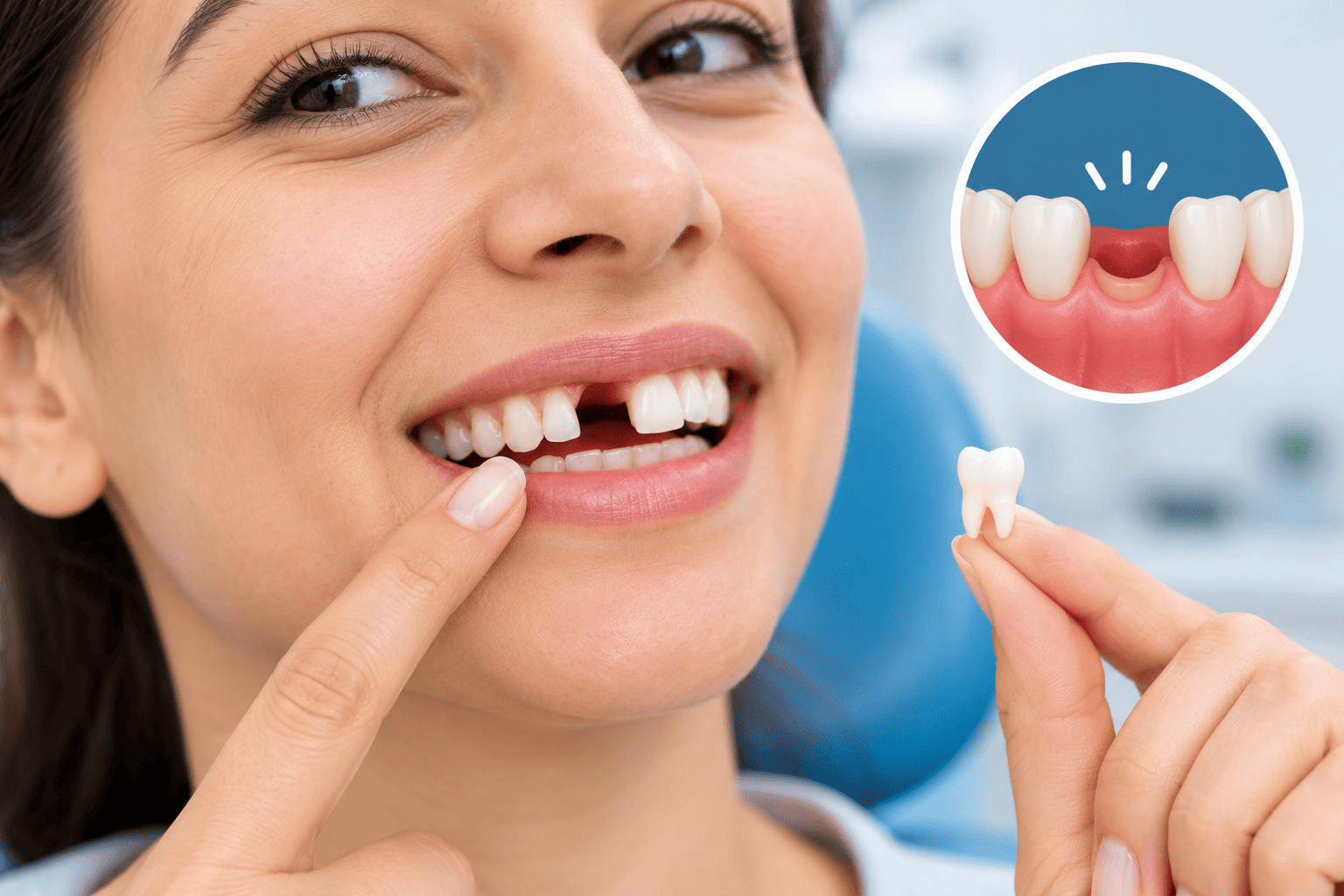
Missing Tooth Solution

What Happens When You Have a Missing Tooth?

Chewing and Everyday Life

Missing teeth can make some foods, such as meat or nuts, harder to bite and chew, so some people start avoiding them. Depending on the location and number of missing teeth, some people may notice changes in their smile, speech or ability to chew. The extent to which these changes affect daily life varies from person to person. Two reviews found that people with fewer teeth, or with difficulty chewing, tended to report a lower quality of life.

Neighbouring Teeth Can Drift

Teeth beside a gap can move towards it. In a study of 143 cases where an upper first molar was lost and a sinus lift (a bone graft that builds up the bone below the sinus) was done, the teeth beside the gap tended to move towards it.

The Jawbone Can Shrink

After a tooth is taken out, the bone that held it begins to reshape and shrink. A systematic review of 20 studies reported reductions in jawbone width of 29% to 63% and height of 11% to 22% in studies that assessed changes after 6 months. These findings reflect the study populations, and the extent of bone changes varies depending on the extraction site and individual healing.

How much changes depends on which tooth is missing, how long ago it was lost and the health of your gums.

How Are Missing Teeth Assessed?

Your dentist examines your mouth and may use X-rays or other scans before suggesting how to replace missing teeth. The assessment looks at:

  • Number and location of missing teeth: Where the gaps are and how many teeth are missing affect which options are open to you
  • Surrounding teeth and gums: Their condition shows whether they can support a replacement
  • Jawbone volume and quality: X-rays or other scans can show how much bone there is
  • Bite and medical history: How your teeth meet, and any health conditions or medicines, help your dentist decide whether surgery, such as an implant, is suitable
  • Tooth decay or gum disease: Either may need treatment before a replacement is considered

Do All Missing Teeth Need to Be Replaced?

Not always. Whether a gap needs filling depends on which tooth is missing, how many teeth are gone and how the rest of your bite is coping. A missing wisdom tooth, for example, often causes no problems and may not need replacing.

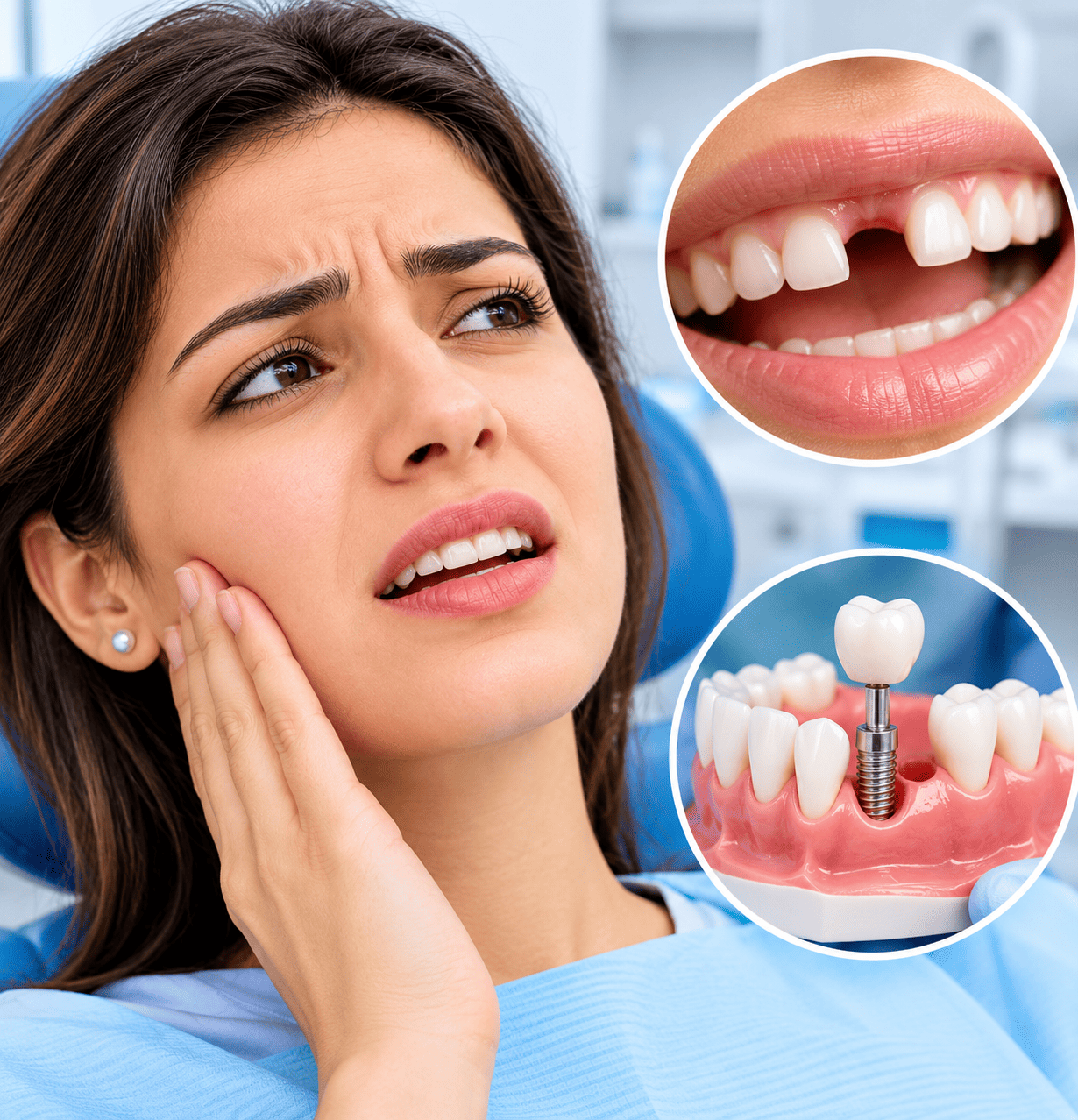
Smiling Woman with Missing Tooth and Dental

Missing Teeth Replacement Options

There are three main ways to replace missing teeth: dental implants, bridges and dentures. Each suits different situations, and your dentist can advise which one fits your mouth.

  Dental implant Dental bridge Denture
Fixed or removable Fixed in the jawbone Fixed in place Removable
What holds it A post (a small screw-like pillar) in the jawbone Crowns (tooth-shaped caps) on the teeth either side of the gap The gums (a partial denture, which replaces only some teeth, may also clip onto natural teeth)
Surgery needed Yes, to place the post No No
How long it lasts In one review, the implant post was still in place in 95.6% of cases after 5 years and 93.1% after 10 years, and the whole implant-supported bridge in 95.4% after 5 years and 80.1% after 10 years. Results for your own teeth can differ In one review, the whole conventional bridge was still in place in 93.8% of cases after 5 years and 89.2% after 10 years. Results for your own teeth can differ Can last for years with good care, but how long varies from person to person
Replacement or revisit Regular dental reviews are needed to monitor implants and their restorations. One systematic review reported complications in approximately one-third of patients with implant-supported fixed restorations over 5 years, although the type and frequency of complications vary between patients. Needs regular check-ups. In one review, 15.7% of patients with conventional bridges had a complication within 5 years, most often decay or loss of vitality in a supporting tooth May need adjusting or replacing as gums and bone change shape, so regular check-ups matter
Suits which situation One tooth or several, when there is enough healthy jawbone and your dentist finds surgery suitable A small gap with healthy teeth on either side that can carry crowns When an implant or bridge is not suitable, or as a temporary step. A partial denture replaces some teeth and a complete denture a whole jaw

Dental Implants

A dental implant is a small post placed in the jawbone to hold a crown, a bridge or a denture. Because it sits in the bone, it does not rely on the teeth beside the gap. Dental implants may be used to replace one or several missing teeth. For patients requiring a full-arch restoration, All-on-4 is one treatment approach that uses four implants to support a fixed dental prosthesis, subject to clinical suitability.

Pros

  • Neighbouring teeth: Dental implants are supported by the jawbone and generally do not require the neighbouring teeth to be reshaped for support.
  • Fixed in the jawbone: The post holds a crown, a bridge or a denture in place
  • One tooth or several: Implants can replace a single tooth, several teeth or, with All-on-4, a full set of teeth on a jaw

Cons

  • Surgery: The post is placed in the jawbone as a surgical procedure
  • Needs enough bone: A shrunken jawbone may make an implant unsuitable
  • Healing period and complications: The new tooth is fitted after a healing period, and complications can occur

Dental Bridges

A dental bridge is an artificial tooth held in place by crowns on the teeth either side. A dental bridge may be considered for a small gap when the neighbouring teeth can provide suitable support. Your dentist will assess the condition of these teeth, your gums and your bite before recommending this option. You can read more about a dental bridge on our page.

Pros

  • No jaw surgery: A bridge needs no surgery in the jaw
  • Fixed in place: The crowns on the teeth either side hold it in position

Cons

  • Neighbouring teeth are reshaped: The teeth either side are trimmed so the crowns can fit over them
  • Supporting teeth matter: A problem with one supporting tooth can affect the whole bridge

Dentures

Dentures are removable replacements. A partial denture fills gaps when some natural teeth remain, and a complete denture replaces all the teeth in a jaw. Dentures are often used when an implant or bridge is not suitable.

Pros

  • No surgery: A denture needs no surgery
  • Removable: A denture can be taken out for cleaning

Cons

  • Can feel loose: A denture can feel loose or move while you eat or speak
  • Cleaning: A denture is cleaned every day and is usually taken out at night

How to Choose a Way to Replace Missing Teeth

A clinical assessment helps determine which missing teeth replacement options may be suitable for you. Beyond that, there are practical factors worth considering:

  • Time: Some treatments take several visits and a healing period before the new tooth is fitted
  • Daily care: Every option needs cleaning and regular check-ups to last

If you are not sure which suits you, a dental consultation lets your dentist examine your teeth, gums and bone and explain your options.

Missing Teeth Cost

The cost depends on how many teeth are replaced, the type of replacement and what your mouth needs, so a fee can only be given after an examination. You can see our dental price list for fees.

Missing Teeth MediSave

The CPF Board allows MediSave to be used for dental implant insertion only when it is a surgical procedure, subject to eligibility and withdrawal limits. Read how MediSave for dental treatment works.

Why Choose Nuffield Dental for Missing Teeth?

  • Clinics across Singapore: Nuffield Dental has 11 clinics, including Raffles Place, Orchard (Jewel), Marina One, Holland Village, Bedok and Jurong East (see our clinic locations)
  • Dentists with a listed interest in implants: Several of our dentists list dental implants among their clinical interests on our dentists page
  • Replacement options explained: Our services include dental implants, a dental bridge and dentures, each described on its own page
  • Four bridge designs: Our dental bridge page describes conventional, cantilever, Maryland and implant-supported bridges
  • Emergency and night dentistry: A response line runs 24 hours, and emergency treatment is available at the Kovan and Bedok clinics until 2:30am upon activation, so call ahead before coming in

FAQs

Teeth that never formed are called hypodontia, the loss of all teeth is called edentulism, and teeth lost after they have grown in are simply called tooth loss.

Yes. A systematic review found that about 6.4% of people are born missing at least one permanent tooth, not counting wisdom teeth. Losing all teeth is less common: the Ministry of Health says the rate of complete edentulism is less than 3% in Singapore's overall population and approximately 13% for those over 60.

There is no single cheapest option, because the cost depends on how many teeth are missing and the type of replacement, and every option has follow-up care that adds to the cost over time.

Yes, some people manage without a molar, but molars do most of the grinding when you chew, and a gap at the back can let the teeth beside it drift towards the space. A dentist can tell you whether yours is worth replacing.

References

Central Provident Fund Board. (n.d.). Can I use MediSave to pay for my dental implant? https://www.cpf.gov.sg/service/article/can-i-use-medisave-to-pay-for-my-dental-implant

Gerritsen, A. E., Allen, P. F., Witter, D. J., Bronkhorst, E. M., & Creugers, N. H. (2010). Tooth loss and oral health-related quality of life: A systematic review and meta-analysis. Health and Quality of Life Outcomes, 8, Article 126. https://doi.org/10.1186/1477-7525-8-126

Khalaf, K., Miskelly, J., Voge, E., & Macfarlane, T. V. (2014). Prevalence of hypodontia and associated factors: A systematic review and meta-analysis. Journal of Orthodontics, 41(4), 299-316. https://doi.org/10.1179/1465313314Y.0000000116

Li, H., Sim, C. P. C., de Rossi Figueiredo, D., & Peres, K. G. (2025). General health-related quality of life and oral health in older adults: A systematic review. Journal of Dentistry, 161, Article 105942. https://doi.org/10.1016/j.jdent.2025.105942

Ministry of Health. (2024, May 7). Edentulism. https://www.moh.gov.sg/newsroom/edentulism/

NHS. (2025, March 19). Dentures (false teeth). https://www.nhs.uk/conditions/dentures/

Pjetursson, B. E., Brägger, U., Lang, N. P., & Zwahlen, M. (2007). Comparison of survival and complication rates of tooth-supported fixed dental prostheses (FDPs) and implant-supported FDPs and single crowns (SCs). Clinical Oral Implants Research, 18(Suppl. 3), 97-113. https://doi.org/10.1111/j.1600-0501.2007.01439.x

Pjetursson, B. E., Thoma, D., Jung, R., Zwahlen, M., & Zembic, A. (2012). A systematic review of the survival and complication rates of implant-supported fixed dental prostheses (FDPs) after a mean observation period of at least 5 years. Clinical Oral Implants Research, 23(Suppl. 6), 22-38. https://doi.org/10.1111/j.1600-0501.2012.02546.x

Tan, W. L., Wong, T. L. T., Wong, M. C. M., & Lang, N. P. (2012). A systematic review of post-extractional alveolar hard and soft tissue dimensional changes in humans. Clinical Oral Implants Research, 23(Suppl. 5), 1-21. https://doi.org/10.1111/j.1600-0501.2011.02375.x

Zhao, F., Shi, L., Huang, Y., Wang, Y., Yu, M., & Wang, H. (2023). Adjacent tooth migration after maxillary first molar loss in patients with sinus augmentation: A retrospective research. Clinical Implant Dentistry and Related Research, 25(6), 1080-1090. https://doi.org/10.1111/cid.13250

medical-appointment 1

Book an Appointment

Fill out the form for any request or questions you have and we will contact you within one working day..

featured-logos-1
background image

Why Choose Nuffield Dental?

Nuffield Dental is a dental clinic in Singapore providing services across several dental disciplines. Treatment is planned after a consultation and clinical assessment.

Dental care

Nuffield Dental provides dental services across several disciplines at its clinics in Singapore. After a consultation and clinical assessment, your dentist sets out the treatment options that apply to your case, what each option involves and what it costs, before treatment begins.

Root Canal Treatment

Our dentists are registered with the Singapore Dental Council. The team includes dentists who provide root canal treatment, oral surgery and dental implant treatment. Each dentist's qualifications and registration details are listed on their profile page.

Articles

The newest and best lifestyle articles selected by our editorial team.

  • 20 Jul 2026
  • 2 mins read
Nuffield Holdings Private Limited Recognised as a Singapore Company of Good

Nuffield Holdings Private Limited is pleased to announce that it has been conferred the Singapore Company of Good 3 Hearts Recognition by the...

Receding Gums in Singapore Causes, Treatment & Cost

What are receding gums? Receding gums happens when the gums draw back from the teeth, hence exposing the roots underneath. The condition is common -...

Mercury-Based Dental Fillings: Global Shifts and Nuffield Dental’s Clinical Approach

Why the Global Phase-Down Is Happening Mercury is listed by the WHO as one of the top ten chemicals of public health concern. In dentistry, the...