Locate Us
tooth leaning right tooth leaning left big tooth big tooth
ceramic-implants

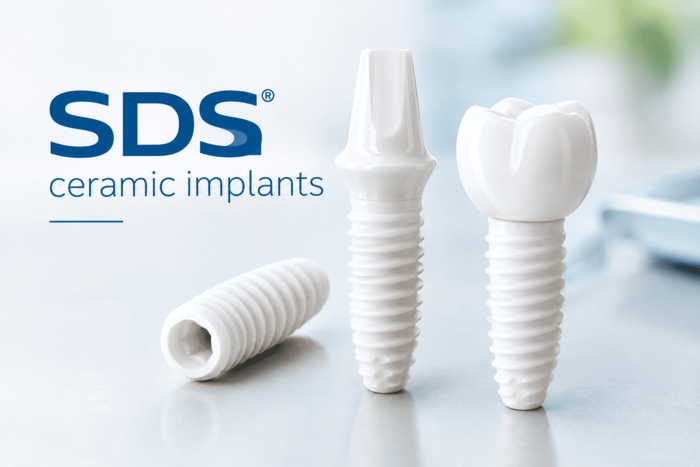
SDS

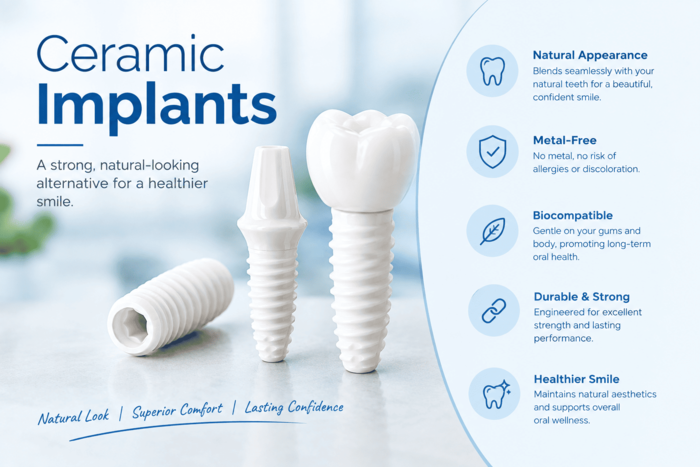
A tooth-coloured implant body made without metal, for people considering an alternative to titanium in their jaw. That's what ceramic implants offer, and SDS is one of the names you'll come across reading about them.

SDS isn't available in Singapore, so it isn't a system we can place. Ceramic implants are, and we work with them as part of our metal-free dental implants service. Most of what draws people to SDS applies to ceramic implants as a group, which is what this page covers.

What Is SDS?

SDS Swiss Dental Solutions is a manufacturer based in Kreuzlingen, Switzerland. It makes zirconia implants and the components that go with them. It doesn't treat patients: your dentist chooses the system and places the implant.

Because the system isn't available here, there's little point going through its specifications. What's worth understanding is the distinction its two product lines illustrate, because that same distinction runs through every ceramic implant on the market.

ceramic-implants-dental

One-Piece and Two-Piece Ceramic Implants

Ceramic implants come in two constructions, and it's the most useful thing to understand if you're weighing one up.


In a one-piece implant, the part in your bone and the post above it are a single object. There is no separate internal connection between the implant and abutment that can loosen, but the angle it enters the bone is the angle your crown sits at, so there's no separate part to adjust it. That puts more weight on planning the position precisely from your scan.


A two-piece implant separates the two, which allows some adjustment of the angle and lets your crown be screwed on rather than cemented. The published research on one-piece designs currently runs longer, and reviews that separate the two tend to report slightly higher survival rates for one-piece designs. Both are in use, and which suits you comes from your own case.

Replacing a Missing Tooth: The Options

An implant is one way to replace a missing tooth. A dental bridge uses the teeth either side of the gap for support, and dentures rest on the gum and come out for cleaning. Which suits you depends on how much bone you have, the condition of the neighbouring teeth, your general health and what you want day to day.

Implant treatment is minor oral surgery and carries the usual risks: infection, swelling and slower healing in some people. An implant can also fail to fuse with the bone, which happens in a small number of cases and is more likely if you smoke or have untreated gum disease. Ceramic implants specifically have a shorter published record than titanium, and fractures, though uncommon, have been recorded more often in narrow ceramic implants. Your dentist will go through all of this before you agree to anything.

What Ceramic Implants Are Made From

Ceramic implants are made from zirconia, a hard white ceramic, manufactured to an international standard for surgical implants.

Zirconia is a ceramic, so there's no metal in the implant body, which is what draws most people to it. One thing to know is that not every component used during treatment is ceramic. Some healing parts are held by small metal screws, and temporary caps are often made from a medical polymer. None of that stays in your mouth once the final crown is fitted, so metal-free describes the result rather than every item used along the way.

The implant surface is roughened by fine blasting, which gives bone more texture to grow onto. Research examining ceramic implants that had failed, across several manufacturers, found that very coarse blasting can leave small surface defects, and that fractures tended to begin at the narrowest point between the threads where the implant meets bone. That's a finding about the material and how it's processed, and it's part of why implant diameter is chosen carefully.

How Well Ceramic Implants Hold Up

Ceramic implants have a shorter research record than titanium, and the available evidence is strongest up to about five years.

What was measured Result
Survival at five years (six studies, 277 implants) 97.2%
Survival at ten years (25 studies, 4,017 implants) 95.1%
Average bone loss at the margin, five years 1.1mm
Survival compared with titanium at one year No significant difference

The professional consensus is more useful than any single figure. The International Team for Implantology concluded in 2023 that zirconia is a valid alternative to titanium, with survival, bone loss and gum health comparable to titanium up to five years, while noting that most of the evidence covers one-piece implants. The European Association for Osseointegration reached a similar view in 2022.

Five years is where the strong evidence currently reaches. Beyond that, your own result depends a great deal on your bone, your gum health, whether you smoke and how carefully the case is planned. These factors are considered during treatment planning.

Ceramic and Titanium Compared

Direct comparisons between the two materials are still few. A 2023 review screened 6,040 papers and found four reporting two randomised trials that compared them head to head, covering 100 zirconia and 99 titanium implants over 12 to 80 months.

  • Survival: no statistically significant difference at 12 months.
  • Appearance of the gum: scores were higher for zirconia, though the reviewers noted that two trials are too few to settle the question.
  • Bone loss at the margin: slightly lower around titanium in both one-piece and two-piece comparisons.
  • Fractures: three were recorded, all in zirconia, all in one-piece designs.
  • Gum health: one case of inflammation, in the titanium group, at 80 months, which is too small a number to draw a conclusion from.

On plaque, a review of 39 studies found ten reporting less early build-up on zirconia, sixteen finding little difference and one finding more, and the authors stopped short of recommending one material over the other. Daily cleaning and regular reviews matter just as much with ceramic as with titanium.

Zirconia isn't magnetic, so it produces less interference on an MRI scan than titanium does. That's a practical point if you expect head or neck scans, and one to mention to your dentist.

Ceramic Implants at Nuffield Dental

Ceramic implants sit within our holistic dentistry service, alongside amalgam replacement and restorative material options. Dr Surinder Arora's clinical work includes biological dentistry and amalgam replacement protocols. Dr Samintharaj Kumar's clinical focus includes ceramic implantology alongside full-arch and zygomatic work.


Whether ceramic suits you is something we work out after imaging rather than something to settle from a website. Bone volume, where the tooth sits, how much angle correction is needed and whether you grind your teeth all feed into it, and for some cases titanium remains the better fit.


If you have a missing tooth, or one your dentist has said cannot be saved, an assessment can help determine which options may be suitable. Imaging may be used to assess the area and support treatment planning. Our dental implants page sets out both materials side by side.

If Your SDS Implants Were Placed Overseas

Some of our patients have had implants placed abroad before settling in Singapore. If that's you, the implant in your jaw isn't the difficulty. The components that attach to it are.

Parts are matched to their own system and don't transfer between manufacturers, so we need to know exactly what you have before ordering anything that has to fit it. Bring the system name, the diameter, the length and the lot number from wherever the implants were placed, and we'll record all four in your notes. If you can't track the paperwork down, bring what you have and we'll work from your records and a scan.

Orchard Dental

Nuffield Dental Jewel
Wheelock Place501 Orchard Road #05-01 Singapore 238880

The Nuffield Dental Clinic Network In Singapore

Nuffield Dental Seletar

Nuffield Dental Seletar
Greenwich V
1 Seletar Road #01-07/08
Singapore 807011

Nuffield Dental Kovan

Nuffield Dental Kovan
Simon Plaza
2 Kovan Road #01-03
Singapore 548008

Nuffield Dental Serangoon Gardens

Nuffield Dental Serangoon Gardens
Serangoon Garden Estate
57 Serangoon Garden Way
Singapore 555953

Nuffield Dental Siglap

Nuffield Dental Siglap
The Domain
914 East Coast Road #01-03
Singapore 459108

Nuffield Dental Bedok

Nuffield Dental Bedok
East Village Mall
430 Upper Changi Road #01-64
Singapore 487048

Nuffield Dental Holland Village

Nuffield Dental Holland Village
7 Holland Village Way #03-16
Singapore 275748

Nuffield Dental Jurong East

Nuffield Dental Westgate
Westgate
3 Gateway Dr #04-32
Singapore 608532

Nuffield Dental Marina One

Nuffield Dental Marina One
The Heart, Marina One
5 Straits View #B2-58
Singapore 018935

Nuffield Dental Jewel

Nuffield Dental Jewel
Wheelock Place
501 Orchard Road #05-01
Singapore 238880

Nuffield Dental Raffles Place

Nuffield Dental Raffles Place
One Raffles Place
1 Raffles Place #05-19
Singapore 048616

FAQs

No, the system isn't available here. Other ceramic implant systems are available in Singapore and may be considered depending on clinical suitability.


The implant body is, and that's the part that stays in your jaw. A few components used during healing aren't, and none of those remain once your final crown is fitted.


Less than titanium. Zirconia isn't magnetic, and imaging research has found ceramic implants stay clearly visible on MRI with only minor distortion, where titanium produced large blank areas. Do tell the radiographer what you have and where before any scan.


Within limits, and how much depends on whether it's a one-piece or two-piece design. Ceramic generally allows less adjustment at the crown stage than titanium, so the position of the implant itself does more of the work. It's one of the things we plan from your scan.

Pooled data puts ceramic survival at 97.2% at five years and 95.1% at ten. Titanium simply has more decades of published follow-up behind it, so your dentist will talk in terms of what's currently known rather than a guaranteed lifespan.

Yes, provided the details are on record. Components are matched to their own system, so a future dentist needs to know exactly what you have. Ask for the system name, diameter, length and lot number to go into your notes on the day, and keep a copy.

Medical References

Al-Nawas, B., Lambert, F., Andersen, S. W. M., Bornstein, M. M., Gahlert, M., Jokstad, A., Jung, J., Kwon, Y. D., Laleman, I., Oteri, G., Roehling, S., Schiegnitz, E., Takeda, Y., & Terheyden, H. (2023). Group 3 ITI Consensus Report: Materials and antiresorptive drug-associated outcomes in implant dentistry. Clinical Oral Implants Research, 34(S26), 169-176. https://doi.org/10.1111/clr.14135

Balmer, M., Payer, M., Kohal, R. J., & Spies, B. C. (2022). EAO position paper: Current level of evidence regarding zirconia implants in clinical trials. International Journal of Prosthodontics, 35(4), 560-566. https://doi.org/10.11607/ijp.8131

Duttenhoefer, F., Mertens, M. E., Vizkelety, J., Gremse, F., Stadelmann, V. A., & Sauerbier, S. (2015). Magnetic resonance imaging in zirconia-based dental implantology. Clinical Oral Implants Research, 26(10), 1195-1202. https://doi.org/10.1111/clr.12430

Kniha, K., Heussen, N., Modabber, A., Hölzle, F., & Möhlhenrich, S. C. (2021). The effect of zirconia and titanium surfaces on biofilm formation and on host-derived immunological parameters. International Journal of Oral and Maxillofacial Surgery, 50(10), 1361-1374. https://doi.org/10.1016/j.ijom.2021.01.021

Mohseni, P., Soufi, A., & Chrcanovic, B. R. (2023). Clinical outcomes of zirconia implants: A systematic review and meta-analysis. Clinical Oral Investigations, 28(1), 15. https://doi.org/10.1007/s00784-023-05401-8

Padhye, N. M., Calciolari, E., Zuercher, A. N., Tagliaferri, S., & Donos, N. (2023). Survival and success of zirconia compared with titanium implants: A systematic review and meta-analysis. Clinical Oral Investigations, 27(11), 6279-6290. https://doi.org/10.1007/s00784-023-05242-5

Roehling, S., Gahlert, M., Bacevic, M., Woelfler, H., & Laleman, I. (2023). Clinical and radiographic outcomes of zirconia dental implants: A systematic review and meta-analysis. Clinical Oral Implants Research, 34(S26), 112-124. https://doi.org/10.1111/clr.14133

 Scherrer, S. S., Mekki, M., Crottaz, C., Gahlert, M., Romelli, E., Marger, L., Durual, S., & Vittecoq, E. (2019). Translational research on clinically failed zirconia implants. Dental Materials, 35(2), 368-388. https://doi.org/10.1016/j.dental.2018.11.033 

medical-appointment 1

Book an Appointment

featured-logos-1
background image

Why Choose Nuffield Dental?

Nuffield Dental is a dental clinic in Singapore providing services across several dental disciplines. Treatment is planned after a consultation and clinical assessment.

Dental care

Nuffield Dental provides dental services across several disciplines at its clinics in Singapore. After a consultation and clinical assessment, your dentist sets out the treatment options that apply to your case, what each option involves and what it costs, before treatment begins.

Root Canal Treatment

Our dentists are registered with the Singapore Dental Council. The team includes dentists who provide root canal treatment, oral surgery and dental implant treatment. Each dentist's qualifications and registration details are listed on their profile page.


Articles

The newest and best lifestyle articles selected by our editorial team.

  • 20 Jul 2026
  • 2 mins read
Nuffield Holdings Private Limited Recognised as a Singapore Company of Good

Nuffield Holdings Private Limited is pleased to announce that it has been conferred the Singapore Company of Good 3 Hearts Recognition by the...

Receding Gums in Singapore Causes, Treatment & Cost

What are receding gums? Receding gums happens when the gums draw back from the teeth, hence exposing the roots underneath. The condition is common -...

Mercury-Based Dental Fillings: Global Shifts and Nuffield Dental’s Clinical Approach

Why the Global Phase-Down Is Happening Mercury is listed by the WHO as one of the top ten chemicals of public health concern. In dentistry, the...