Locate Us
tooth leaning right tooth leaning left big tooth big tooth
Wisdom Tooth Extraction Explained

Wisdom Tooth Extraction vs Surgery

Being told your wisdom tooth needs "surgery" can sound more serious than the "extraction" you were expecting. It is also confusing when one clinic says extraction and another says surgery for what sounds like the same tooth. Whether you need an extraction or surgery affects how long you take to recover, what you pay and whether MediSave applies.

Your dentist determines whether a simple extraction or surgical removal is needed based on the tooth's position, accessibility and surrounding structures. Here is how the two compare and when surgery is needed, along with what is expected and when you should see a dentist.

What Is the Difference Between Wisdom Tooth Extraction and Surgery?

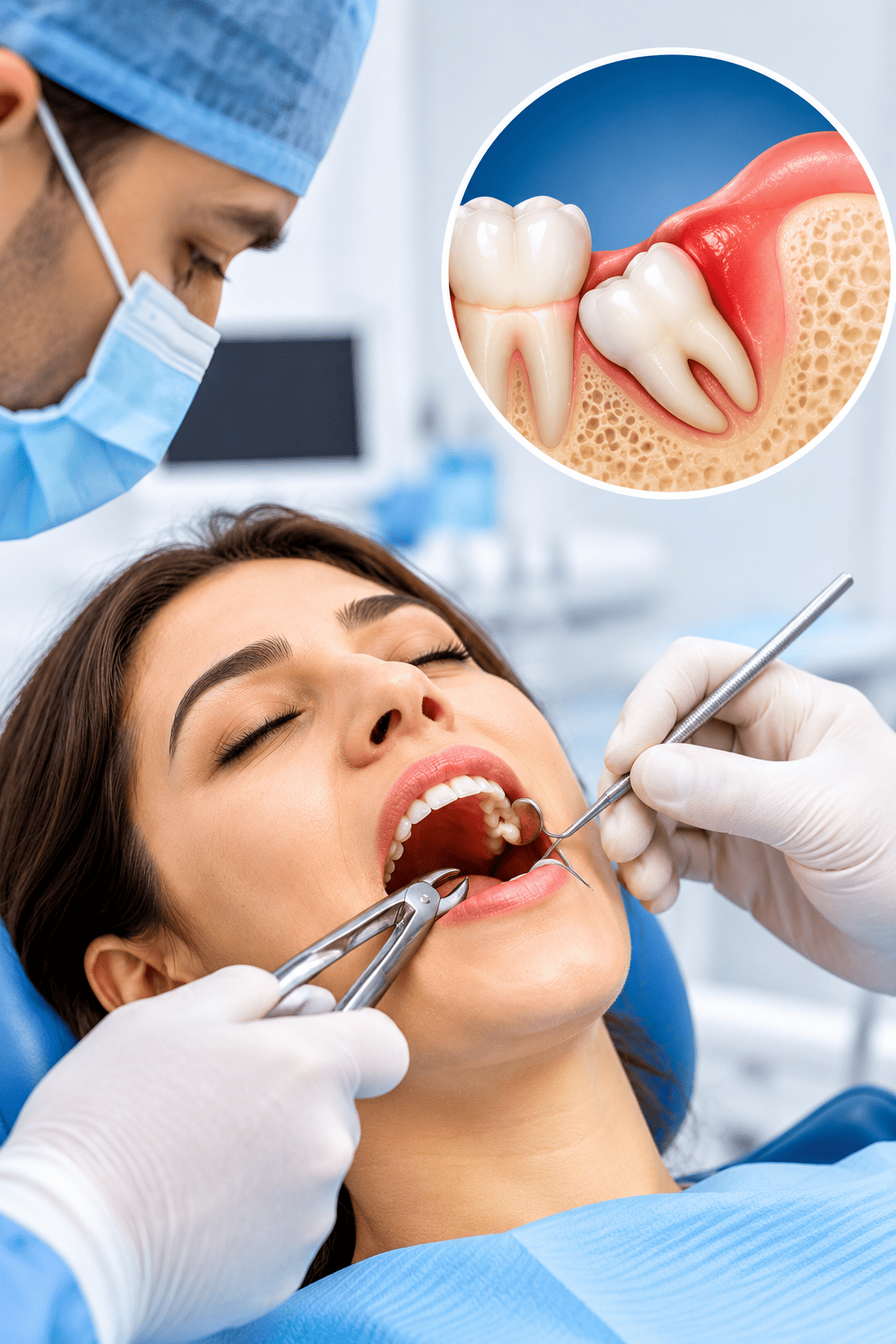
A simple extraction is for a wisdom tooth that has come through the gum and can be reached directly. Wisdom tooth surgery is for a tooth that is covered by gum or bone, or tilted so that it cannot be reached directly. The dentist lifts a small flap of gum to uncover it.

In everyday use, "extraction" is usually for straightforward cases and "surgery" is for more complex ones. Your dentist decides which one applies. If the tooth is not a wisdom tooth, see our guide to tooth extraction.

Impacted Wisdom Tooth Relief

Wisdom Tooth Extraction vs Surgery at a Glance

  Simple wisdom tooth extraction Wisdom tooth surgery
How the dentist reaches the tooth Directly, above the gum Through a lifted flap of gum, sometimes with bone removed
How the tooth comes out Lifted out whole May be cut into pieces first
Stitches Less likely More likely
After-effects Some soreness and swelling can occur Usually more soreness and swelling afterwards
MediSave Not claimable, as only surgical removal qualifies (see below) Subject to eligibility and withdrawal limits (see below)
Anaesthesia Local anaesthetic to numb the area Local anaesthetic, sometimes with sedation or general anaesthesia
Wisdom_Tooth_Extraction

Simple Wisdom Tooth Extraction

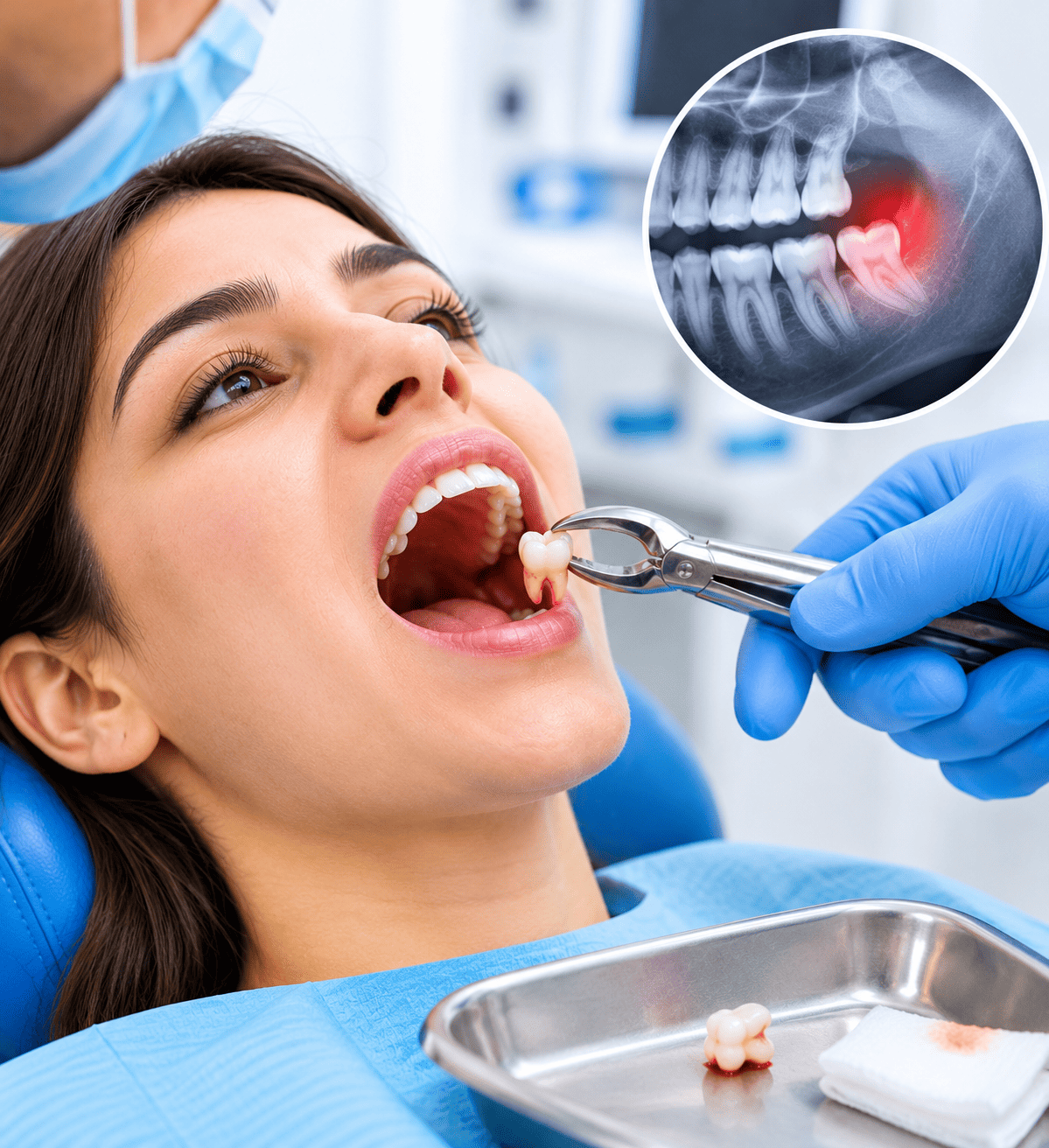
The dentist numbs the area, loosens the tooth with an instrument and lifts it out with forceps. A simple extraction generally does not require cutting the gum when the tooth is accessible. It may be suitable for a wisdom tooth that has fully erupted, depending on its root structure, position and the surrounding bone.

Wisdom Tooth Surgery

Wisdom Tooth Surgery

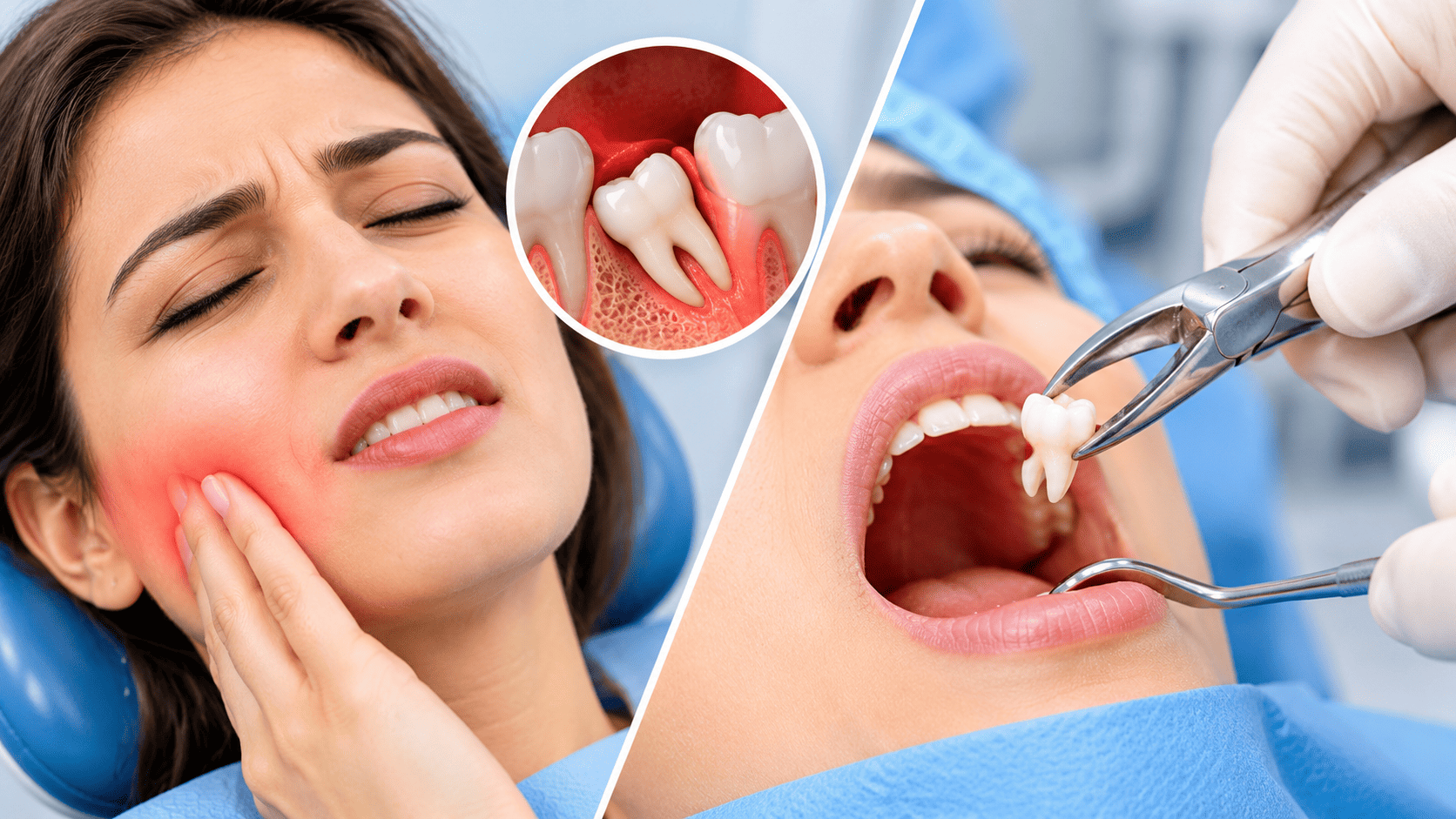
In surgical removal, the dentist lifts a small flap of gum to reach the tooth. Some of the bone around the tooth may be removed, and the tooth may be cut into pieces so that each piece can come out through a smaller opening. Stitches may be placed afterwards to close the gum.

The word "surgery" only describes how the dentist reaches the tooth. How long the procedure takes and which type of anaesthetic is used depend on your case, so ask your dentist about both.

When Do You Need Wisdom Tooth Surgery Instead of Extraction?

Surgery is usually advised when the tooth cannot be reached or lifted out directly. Common reasons include:
  • Impacted tooth: The tooth is trapped under the gum or in the jawbone, so the dentist must lift the gum to reach it (see our impacted wisdom tooth guide)
  • Angled or horizontal tooth: A tooth tilted towards the next molar or lying on its side cannot be pulled straight out
  • Partly erupted tooth: Only part of the crown shows and gum still covers the rest

Dentists judge how difficult a lower wisdom tooth will be from how deep it lies, how much room there is between it and the jawbone behind it, and its angle. The Singapore Dental Council lists these factors for assessing surgical difficulty and anticipating complications.

This table shows how the position of the tooth usually points to one approach or the other. Your dentist confirms the choice after an examination and X-ray.

Tooth position What the dentist finds Usual approach
Fully through the gum The tooth sits above the gum with nothing blocking access May suit a simple extraction
Partly through the gum Only part of the crown shows and gum still covers the rest Surgery may be needed
Impacted The tooth is trapped under the gum or in the jawbone Surgery, as the dentist must lift the gum to reach it
Angled or lying on its side The tooth tilts towards the next molar or lies flat, so it cannot be pulled straight out Surgery may be needed
Roots close to a nerve The X-ray shows roots near the nerve that gives feeling to the lower lip and chin Surgery with more careful planning

Why Your Dentist Needs an X-ray

Your dentist cannot judge the roots, the bone around them or the nerve by looking in your mouth, but an X-ray shows them. A tooth fully above the gum with nothing blocking access may suit a simple extraction, while gum or bone covering it usually means surgery. Curved or multiple roots, roots close to the lower jaw nerve or the upper sinus, and signs of damage to the neighbouring molar can also point to surgery and need careful planning.

Not Every Impacted Tooth Needs to Come Out

A wisdom tooth that is not causing problems may be monitored instead of removed. Surgical removal may be considered when a wisdom tooth causes recurring pain, swelling or infection, depending on the clinical findings. Your dentist will assess whether removal or continued monitoring is appropriate. If you are unsure whether yours needs to come out, a dental consultation is a good place to start.

Is Wisdom Tooth Surgery More Painful Than Extraction?

Surgery can leave you more sore afterwards than a simple extraction because it disturbs more gum and sometimes bone, even though both use anaesthetic. A Cochrane review notes that surgical removal is commonly followed by short-term pain, swelling and trismus, which is a stiff jaw that is hard to open fully.

Having bone removed during the operation is linked to more pain and swelling afterwards, which is one reason surgery tends to be sorer.

Recovery Time After Wisdom Tooth Extraction vs Surgery

Pain, swelling and stiffness may begin to ease after the first few days, although recovery varies depending on the complexity of the procedure and individual healing. Some patients may experience symptoms for longer, so follow your dentist's aftercare instructions and seek advice if symptoms worsen. Your dentist will give aftercare instructions for your own procedure, and our guide to wisdom tooth pain explains what to do if soreness is not settling.

Complications After Wisdom Tooth Removal

  • Dry socket: The blood clot in the socket is lost early, leaving the area sore
  • Infection: Bacteria enter the wound and cause swelling, pain or pus
  • Nerve injury: Numbness or tingling in the lip, chin or tongue, which is often temporary but can be permanent. Damage to a nearby tooth or the sinus: Removal can damage the tooth next to it, and because the roots of an upper wisdom tooth sit close to the sinus, it can sometimes leave a small opening between the mouth and the sinus

The risk of certain complications may be higher when a wisdom tooth is deeply impacted, positioned at an angle or located close to surrounding nerves. Your dentist will assess these factors when planning the procedure and explaining the risks involved.

Before treatment begins, your dentist can assess which risks apply to your tooth. If numbness is not easing, or pain or swelling is getting worse after the first few days, contact your dentist early, and do the same if you notice fever, pus, a bad taste or you feel unwell. If swelling makes it hard to swallow or breathe, seek urgent medical care at once. If you cannot reach your usual clinic, see our emergency dentist service.

07 Wisdom tooth pain2

Who Is Qualified to Do Wisdom Tooth Surgery?

The Singapore Dental Council (SDC) recommends that dentists who perform wisdom tooth surgery hold a Certificate of Competency (COC), introduced in July 2026, or a Master of Dental Surgery in Oral and Maxillofacial Surgery, although the COC is not mandatory. Its circular says wisdom tooth surgery carries higher risks than routine dental procedures and varies considerably in complexity.

The COC covers lower wisdom teeth up to an intermediate level of difficulty. Cases of greater complexity are meant to be referred to oral and maxillofacial surgeons.

Questions to Ask Before Wisdom Tooth Surgery

  • Does my tooth need a simple extraction or surgery? The answer sets the cost and recovery you should plan for
  • What does my X-ray show about the nerve? It helps you judge the risk of numbness
  • What training do you have in wisdom tooth surgery? It shows how your dentist has prepared for this type of surgery
  • Would my case suit an oral and maxillofacial surgeon? A tooth that is very deep or close to a nerve may call for one
  • What type of anaesthetic will I have? It tells you what to expect on the day
Clinical Wisdom Tooth Extraction

Wisdom Tooth Extraction vs Surgery Cost

A simple extraction usually costs less than wisdom tooth surgery, because surgery involves lifting the gum, sometimes removing bone and placing stitches. At Nuffield Dental, a simple extraction is estimated at SGD $174.40 to SGD $392.40 per tooth and a complex surgical extraction at SGD $817.50 to SGD $1,689.50 per tooth, including 9% GST.

The exact fee depends on the number of teeth removed, the complexity of the procedure and any additional treatment required. Your dentist can provide an itemised estimate following a clinical assessment. Our guide to wisdom tooth extraction cost explains the fees.

Wisdom Tooth Extraction vs Surgery MediSave

The CPF Board allows MediSave for wisdom tooth removal at a participating private dental clinic only when it is a surgical procedure, and claims are subject to eligibility and withdrawal limits. Ask your dentist whether your procedure qualifies, and read how wisdom tooth extraction MediSave claims work.

Why Choose Nuffield Dental for Wisdom Tooth Removal?

  • Clinics across Singapore: Nuffield Dental has 11 clinics, including Raffles Place, Orchard (Jewel), Marina One, Holland Village, Bedok and Jurong East (see our clinic locations)
  • Assessment with imaging: The assessment may include an X-ray or CBCT scan to show the exact position of the tooth
  • Anaesthesia options: Wisdom tooth removal is commonly performed under local anaesthesia. Sedation or general anaesthesia may be considered for suitable cases, depending on the procedure, medical history and clinical assessment
  • Dentists with a listed interest: Dr Faisal Bin Abdul Aziz, Dr Siah Yien Kiat Kenneth and Dr Ali-Safdar Ireen Mozamil list wisdom tooth surgery or removal among their clinical interests, and education and qualifications are listed on our dentists page

You can read more on our wisdom tooth extraction page.

FAQs

Yes, if the tooth has fully come through the gum and can be reached directly, a simple extraction may be considered. Your dentist confirms whether this applies to you.

A coronectomy removes the crown of the tooth and leaves the roots in the jaw. It is sometimes considered when the roots lie very close to a nerve. A systematic review reported a lower risk of nerve injury following coronectomy compared with complete removal in selected high-risk wisdom tooth cases. However, coronectomy is not suitable for every patient, and the decision depends on the tooth's condition and position.

For its guidelines, the SDC defines wisdom tooth surgery as surgical intervention on an impacted lower wisdom tooth when there is clinical or X-ray evidence that it should be removed.

References

Bailey, E., Kashbour, W., Shah, N., Worthington, H. V., Renton, T. F., & Coulthard, P. (2020). Surgical techniques for the removal of mandibular wisdom teeth. Cochrane Database of Systematic Reviews, 2020(7), Article CD004345. https://doi.org/10.1002/14651858.CD004345.pub3

Central Provident Fund Board. (n.d.). Can I use MediSave to pay for the removal of my wisdom tooth? https://www.cpf.gov.sg/service/article/can-i-use-medisave-to-pay-for-the-removal-of-my-wisdom-tooth

Daware, S. N., Balakrishna, R., Deogade, S. C., Ingole, Y. S., Patil, S. M., & Naitam, D. M. (2021). Assessment of postoperative discomfort and nerve injuries after surgical removal of mandibular third molar: A prospective study. Journal of Family Medicine and Primary Care, 10(4), 1712-1717. https://doi.org/10.4103/jfmpc.jfmpc_280_19

NHS. (n.d.-a). Dental abscess. https://www.nhs.uk/conditions/dental-abscess/

NHS. (n.d.-b). Wisdom tooth removal. https://www.nhs.uk/conditions/wisdom-tooth-removal/

Pitros, P., O'Connor, N., Tryfonos, A., & Lopes, V. (2020). A systematic review of the complications of high-risk third molar removal and coronectomy: Development of a decision tree model and preliminary health economic analysis to assist in treatment planning. British Journal of Oral and Maxillofacial Surgery, 58(9), e16-e24. https://doi.org/10.1016/j.bjoms.2020.07.015

Sayed, N., Bakathir, A., Pasha, M., & Al-Sudairy, S. (2019). Complications of third molar extraction: A retrospective study from a tertiary healthcare centre in Oman. Sultan Qaboos University Medical Journal, 19(3), e230-e235. https://doi.org/10.18295/squmj.2019.19.03.009

Singapore Dental Council. (2026, July 29). SDC Circular No. 1/2026: Better competency development for safe and quality dental care for patients. https://go.gov.sg/sdc-circular-2026-better-competency-development-for-safe-and-quality-dental-care

Singapore Dental Council. (2026). FAQs: Certificate of Competency for wisdom tooth surgery. https://go.gov.sg/faqs-coc-for-wisdom-tooth-surgery

Vranckx, M., Fieuws, S., Jacobs, R., & Politis, C. (2021). Prophylactic vs. symptomatic third molar removal: Effects on patient postoperative morbidity. Journal of Evidence-Based Dental Practice, 21(3), Article 101582. https://doi.org/10.1016/j.jebdp.2021.101582

Yadav, D., Ranjan, R., Mubashir, M. M., Koul, M., Sachdev, S. S., & Sharma, P. (2026). Risk factors associated with inferior alveolar and lingual nerve injury following surgical extraction of impacted mandibular third molars: A retrospective cohort study. Cureus, 18(7), Article e113638. https://doi.org/10.7759/cureus.113638


medical-appointment 1

Book an Appointment

Fill out the form for any request or questions you have and we will contact you within one working day..

featured-logos-1
background image

Why Choose Nuffield Dental?

Nuffield Dental is a dental clinic in Singapore providing services across several dental disciplines. Treatment is planned after a consultation and clinical assessment.

Dental care

Nuffield Dental provides dental services across several disciplines at its clinics in Singapore. After a consultation and clinical assessment, your dentist sets out the treatment options that apply to your case, what each option involves and what it costs, before treatment begins.

Root Canal Treatment

Our dentists are registered with the Singapore Dental Council. The team includes dentists who provide root canal treatment, oral surgery and dental implant treatment. Each dentist's qualifications and registration details are listed on their profile page.

Articles

The newest and best lifestyle articles selected by our editorial team.

  • 20 Jul 2026
  • 2 mins read
Nuffield Holdings Private Limited Recognised as a Singapore Company of Good

Nuffield Holdings Private Limited is pleased to announce that it has been conferred the Singapore Company of Good 3 Hearts Recognition by the...

Receding Gums in Singapore Causes, Treatment & Cost

What are receding gums? Receding gums happens when the gums draw back from the teeth, hence exposing the roots underneath. The condition is common -...

Mercury-Based Dental Fillings: Global Shifts and Nuffield Dental’s Clinical Approach

Why the Global Phase-Down Is Happening Mercury is listed by the WHO as one of the top ten chemicals of public health concern. In dentistry, the...